
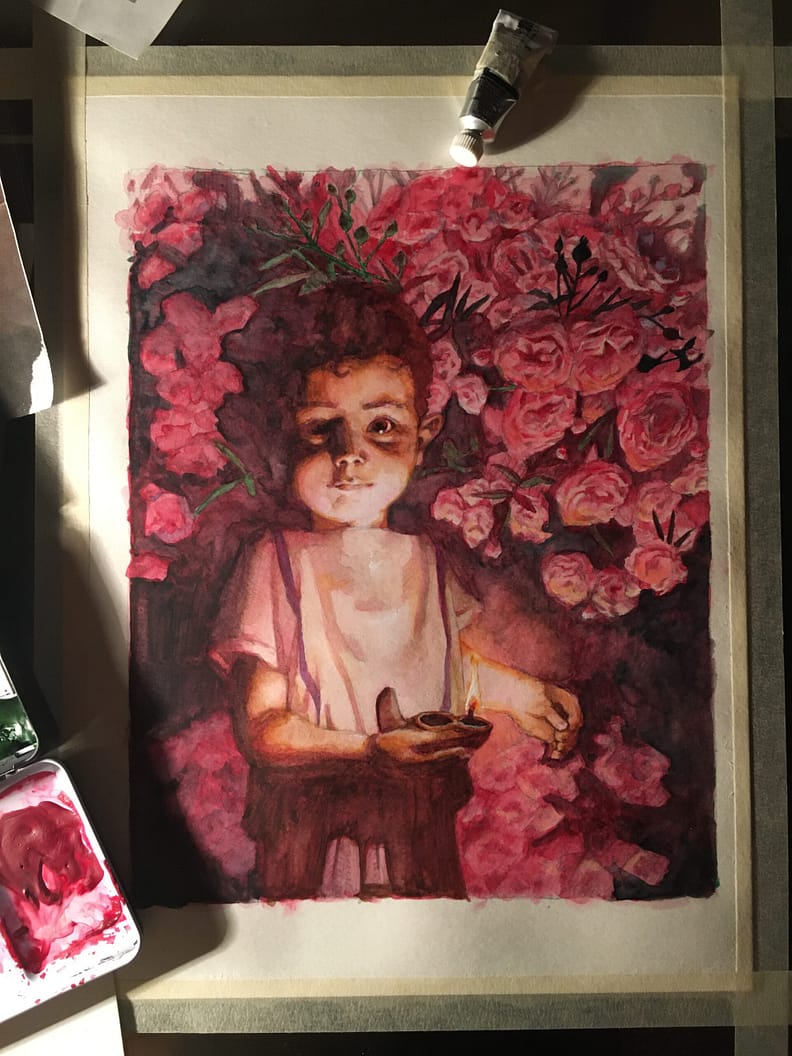
This painting is intended for a Christmas card featuring a verse from the hymn “Lo, How a Rose E’er Blooming.”
This flow’r, whose fragrance tender
With sweetness fills the air,
Dispels with glorious splendor
The darkness everywhere.
True man, yet very God,
From sin and death He saves us
And lightens ev’ry load.
I think this is the most challenging piece I’ve worked on in a while. The first difficulty lighting the face. Lighting from below is fairly uncommon in portraiture; in real life, we’re used to seeing people lit mostly from above, and the opposite situation can feel uncanny or even ominous. On top of that, baby and toddler faces lack many of the sharp, hard features that serve as landmarks in an adult face, which makes drawing or painting them difficult. Approaching these two challenges using separate reference images would have been impossible. Fortunately, my son was delighted to model for me, since it meant a rare chance to play with Papa’s booklight.
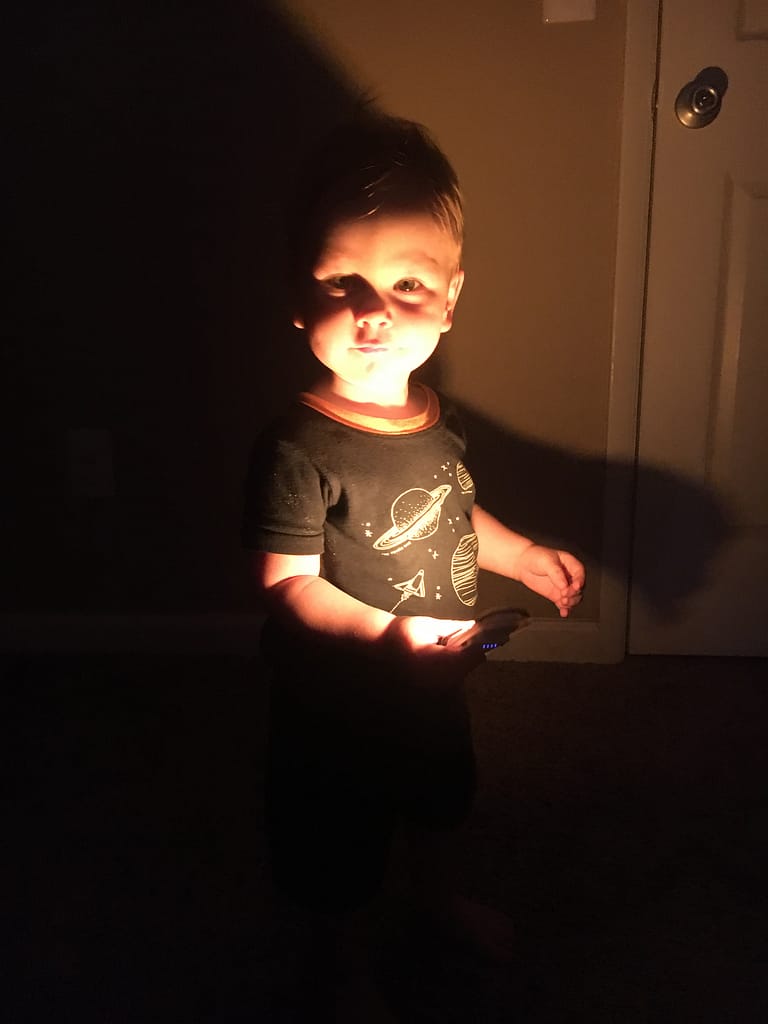
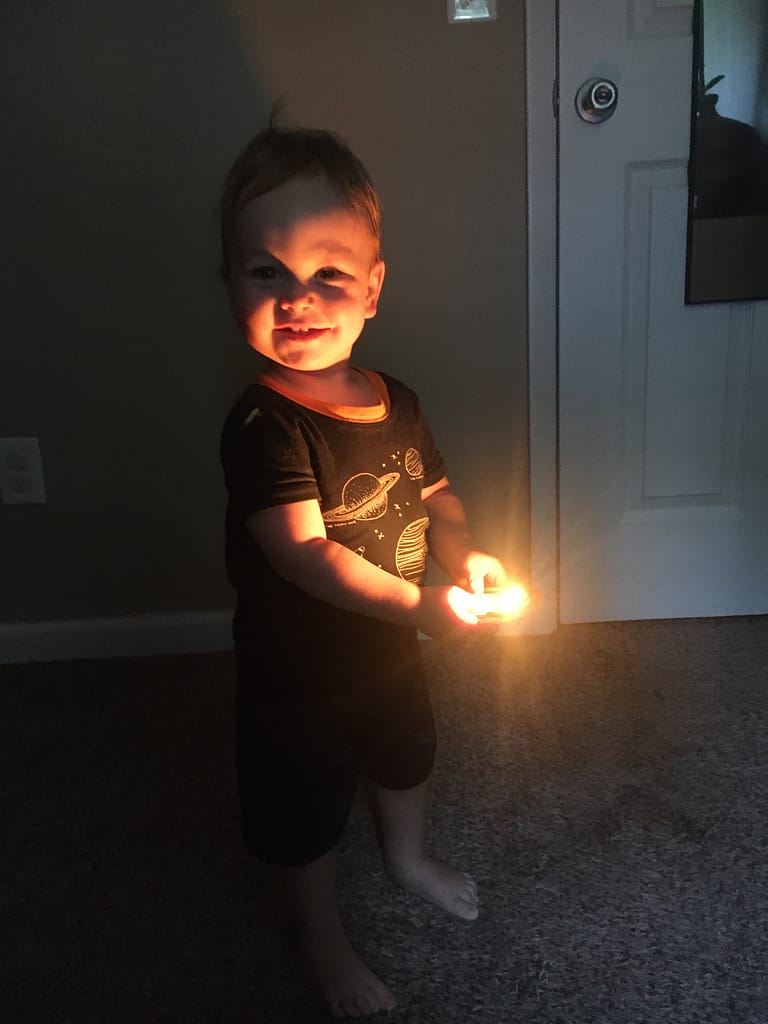
Once I had a solid reference image, I was able to work out the composition with thumbnails before moving on to a more serious sketch. I’d recently done a lot of other art for greeting cards where the originals were the same size as the images on the cards would appear, about 4×5″, and I started out doing the same for this piece. But once I started painting over the sketch, I found this was too small a scale for the details on the face, and especially for the roses, none of which were more than half an inch across. I had to scrap my first painting about halfway through. Mercifully, I had scanned my sketch before I began painting it, so I was able to print it out at a larger size and use a lightbox to transfer the sketch onto watercolor paper.


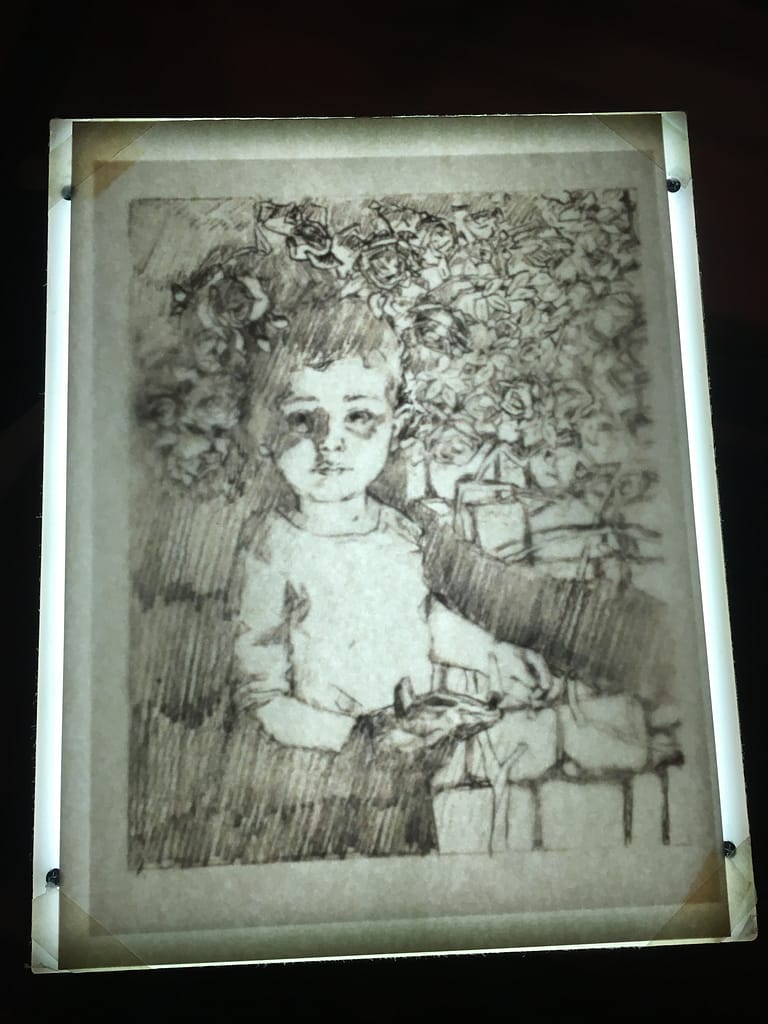
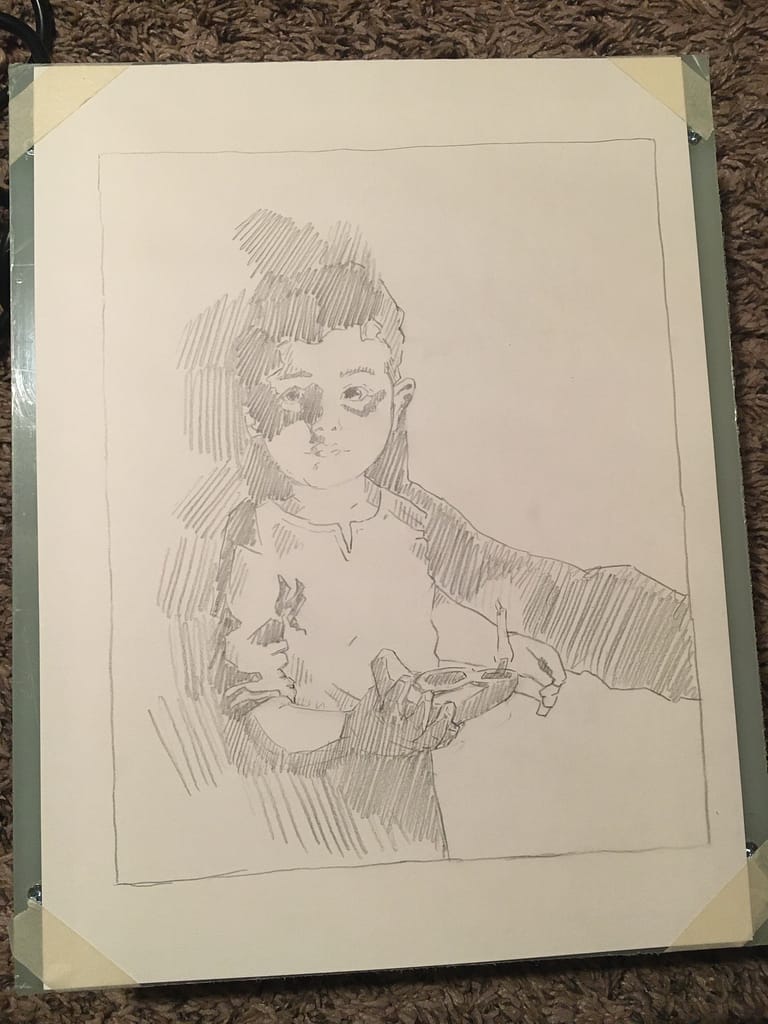
Once the rough sketch was retraced, I did some major work before I ventured into painting again. I felt the roses were too sparse, and I couldn’t make sense of their lighting, so I completely redrew the background. I repositioned the lamp and the hand holding it to look more natural and adjusted the proportions of the arm. I also completely redrew the tunic as a chiton, which would have been common attire for a first-century Jew in the eastern Roman empire. From the beginning, I had wanted a historically accurate depiction of what Jesus might have looked like as a toddler, so even in the original sketch and painting, I had tried to make the child in the picture look more Middle-Eastern than my own very European-looking son: besides darkening the hair, eyes, and eyebrows and shifting the skin tone, I had also tried to make subtle changes to the shape of the nose and mouth. In the first sketch, I think I accidentally made the child look too old in the process, and a lot of detail was lost in the painting. Redrawing the sketch at a larger size gave me the opportunity to improve the facial features in both apparent age and ethnicity.


Once I was confident that I had worked out most of the picture’s problems in the new sketch, my next step was to try something I’ve not often done before: an underpainting. The idea is to work out the light and shadows of a piece using a single paint color, which often shows through in places under the subsequent layers, which add the final colors to the image. I’d tried the technique with oil paint once or twice, but never with watercolor. It required me to rethink how I mixed my final colors, since unlike with oil, adding new layers would rewet the underpainting and cause it to mix somewhat with the new paint. Underpainting gave me the opportunity to improve on my previous painting in yet another way: I wanted the red of the roses to dominate the whole image. For this reason, I went with a reddish-pink underpainting: a mix of Alizarin Crimson Hue and Permanent Rose.
Adding on the final colors went much faster than I anticipated and was a lot more fun with the major difficulties all resolved, though my perfectionist tendencies still left me overworking the paper in several spots. I’m often asked how long it takes me to do a painting; in this case, from the lightbox tracing to completion took me almost exactly the length of an audiobook of Jane Austen’s “Emma.” The previous sketch and painting probably took about half that time: overall, at least 24 hours worth of work.
Hymn text is public domain.